
Research theme
Colour, Consciousness & Qualia Drift
Empiricist theories of qualia paired with experimental studies of colour adaptation, learned perception, and altered visual conditions.
Why colour qualia
Everyone knows what blue looks like. We use it for sky and sea, for moods and melodies, yet no physical description of light explains why that band feels calm or distant. The gap between wavelength and lived character is the classical qualia problem. We take a concrete stance:
The blueness of blue is not in the light; it is in the structure of a life lived under that light.
Qualia are learned associations between perception, affect, and environment. Colours are not intrinsic mental atoms. They are the way a nervous system summarises stable regularities in its world.
Core idea: qualia as learned association
The theory in The Blue Is Sky and the associative-qualia draft rests on three points:
- Things and properties. Each colour is tied to characteristic clusters of objects and properties (sky/sea/coolness for blue, blood/fire/warmth for red). The feel of a colour synthesises the properties that travel together in the world.
- Associative networks. Perception recruits distributed networks linking sensory states to context and affect. Repeated co-occurrence binds those elements; over time they form a stable experiential “tone”.
- Experience as recollection. Seeing a colour reinstates that network. Qualia are the subjective side of learned association—the world remembering itself in the organism.
Qualia drift
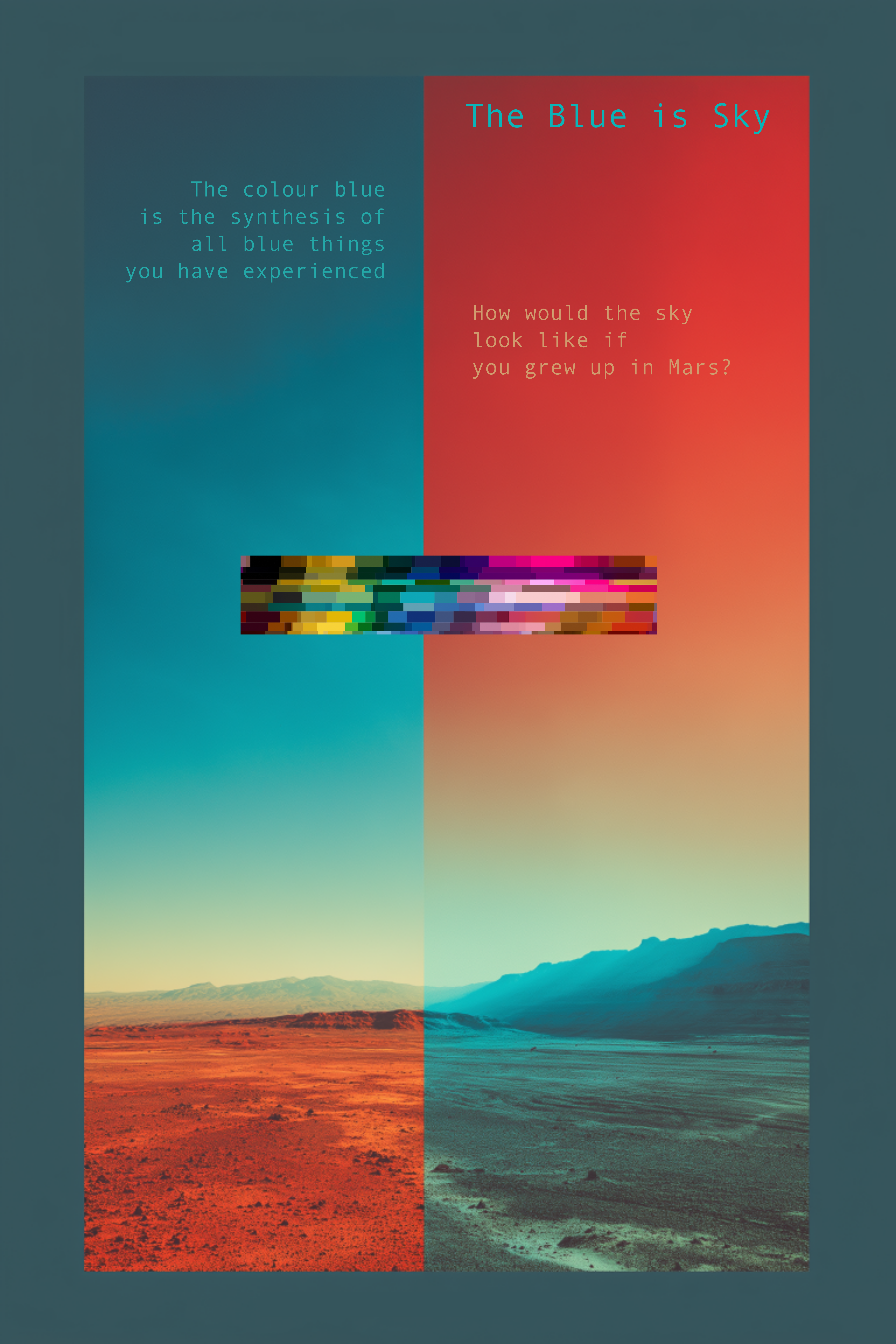
If colours are learned in this way, they should be plastic. Change the statistics of the environment and the qualitative character should move with them. The Mars thought experiment captures it: a child raised under a red sky will attach the feel of openness and breathable air to that band. From our perspective the sky is “red”; for the child it fills the role of “blue”. We call this reorganisation qualia drift and treat colour as the main testbed for observing it.
From theory to experiment
Colour lets us connect first-person experience, theory, and measurement. Current work translates the theory into data:
- Altered visual conditions. We study whether sustained changes in visual input can produce durable shifts in colour experience rather than short-lived adaptation effects.
- Longitudinal perceptual change. The experiments ask how naming, memory, discrimination, preference, and affect reorganise over repeated encounters with modified sensory environments.
- Computational and behavioural studies. We pair behavioural observations with modelling work to understand when category boundaries become unstable, when new distinctions emerge, and how those changes persist.
- Diaries and structured phenomenology. Participants and in-house agents document when familiar scenes begin to feel reclassified, when colour language starts to shift, and how those changes interact with mood and meaning.
The point is not simply perceptual adaptation. It is tracing how the felt character of colour, and the emotions attached to it, reorganise under controlled changes in visual experience.
Place in consciousness research
Colour grounds classic puzzles like inverted spectra and Mary the colour scientist. The associative theory reframes those problems:
- “Is my blue your blue?” becomes “How similar are our environmental histories?”
- Behaviourally identical minds with wildly different qualia become unlikely because ecological structure constrains the learned associations.
- Mary’s “new fact” is the acquisition of an associative pattern, not an encounter with a primitive mental atom.
The hard problem becomes concrete: explain how associative networks acquire specific qualitative tones and how they drift under controlled changes.
Beyond colour: the relational brain
The same machinery that builds colour qualia extends to aesthetic experience. The relational brain project treats beauty and meaning as recognition of patterned relations—how elements cohere, echo, or clash—rather than as reactions to isolated features. Colour is simply the cleanest case for watching these associative networks update.
Implications
- Philosophy of mind. Provides an empiricist account in which qualia are neither mystical simples nor illusions, but learned bindings of perception, affect, and environment.
- Empirical consciousness science. Turns questions like “why does blue feel calm?” into experiments by manipulating visual and ecological structure.
- Aesthetics and culture. Offers language for how artificial lighting, screens, and synthetic pigments may literally reshape colour qualia, not just their associations.
- AI and artificial consciousness. Frames the requirements for qualia-like structures in machines: rich world interaction, memory, and affective coupling that could support comparable associative networks.
Reports and drafts
- The Blue Is Sky – an essay that builds the associative picture from everyday experience, Martian thought experiments, and technological light.
- Associative qualia draft – the full theoretical paper, The Blue Is Sky: Toward an Associative Theory of Qualia, with predictions and experimental plans.
- The Relational Brain – an essay that extends the same logic to neuroaesthetics, arguing for relational structure as the driver of aesthetic feeling.